
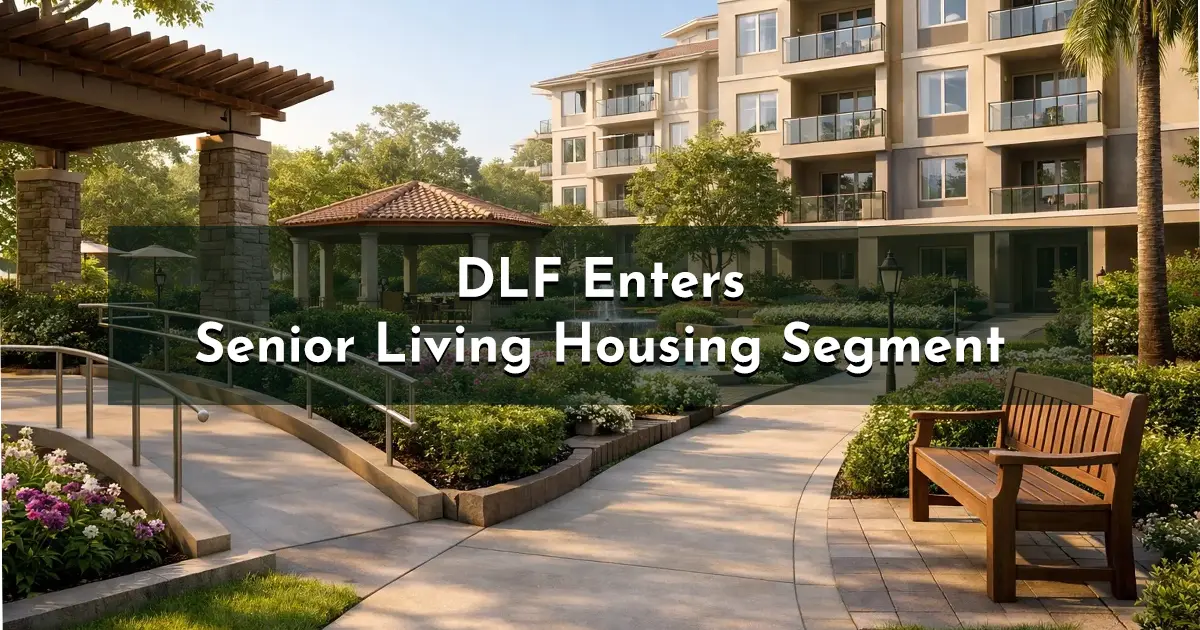
DLF Ltd, the top real estate developer in India according to market capitalization, has announced its first senior living housing project at a location in Gurugram.
The company decided to enter this market because it needed to develop its growth plan and because India’s residential real estate sector was undergoing structural changes.
DLF developed its senior living housing program to meet upcoming demographic needs while it planned to expand its business beyond traditional residential housing, which would generate potential revenue of ₹2,000 crore.
The demand for organized age-specific housing solutions has increased as life expectancy increases, families become smaller, and urban seniors gain financial independence.
DLF Enters Senior Living Housing Segment functions as a social project that creates sustainable business opportunities because it solves current housing needs for elderly people.
See also: Advantages of Old Age Homes: The Rise of Senior Living Trend
Strategic Rationale Behind DLF’s Entry into Senior Living
DLF expanded into DLF senior living housing because of two factors, which include strong demographic fundamentals and the ability to forecast demand over extended periods.
India’s population aged 60 years and above is expected to grow from approximately 162 million in 2025 to nearly 191 million by 2030, and the population will continue to grow until it reaches approximately 346 million by 2050.
The change is altering housing choices for urban seniors who want to live independently in apartments while having secure access to healthcare and a properly maintained living space.
DLF decided to enter the senior living market because of these important strategic factors:
The Indian population of elderly individuals is expanding rapidly because people live longer now.
More urban senior citizens achieve financial independence from their families.
People today prefer nuclear family units instead of traditional joint family structures.
There exist very few organized housing facilities which cater to the specific needs of senior citizens.
People increasingly prefer residential arrangements which provide them with an active community lifestyle.
Conventional residential housing and traditional old-age homes are increasingly proving inadequate for this evolving cohort. Seniors today require homes which support their active lifestyle while providing them with safety for emergencies.
Senior living housing provides dedicated residences together with professional management and social living spaces to fulfill this requirement.
DLF benefits from this market segment because it provides business expansion opportunities to create business stability and meet the evolving needs of its customers. The Gurugram project will function as a pilot, which will enable the company to develop similar projects in other large urban areas.
See also: Transfer of Property Act: Key to Secure Real Estate Deals
Market Potential of Senior Living Housing in India
The senior living sector in India is currently experiencing rapid growth. Projections indicate that nearly 15,000 senior living units could be operational by 2030, involving investments of approximately ₹26,000 crore. Higher growth scenarios would enable supply to exceed 25,000 units through investments, which would reach nearly ₹39,000 crore.
The demand for products exists at levels which exceed the supply available in the market. The urban, financially independent senior population alone is expected to require nearly 2.3 million housing units by 2030, compared to an estimated requirement of 1.7 million units in 2025.
The existing market gap provides developers who possess excellent execution skills with a major chance to succeed.
DLF Enters Senior Living Housing Segment at a stage when market awareness, acceptance, and aspiration for senior-focused housing are steadily increasing.
Alignment with DLF’s Broader Growth Strategy
The entry of DLF into senior living housing markets supports their medium-term growth targets. The company experienced lower sales bookings during the December-end quarter because of its product launch schedule.
However, management remains confident that the company will achieve its full-year sales goals because of its strong project pipeline.
DLF now possesses development rights which cover 280 million square feet of residential and commercial property. The company expands its business through senior living housing, which strengthens its diversification efforts.
The company built its brand credibility through delivery expertise, which enabled it to broaden its residential housing portfolio.
The ultra-luxury residential projects from DLF experienced continuous demand while prices for these projects increased. This success proves that DLF residential projects create value while enabling the company to enter new business markets.
See also: What Is a Mother Deed in Real Estate?
Investment Perspective on DLF Senior Living Housing
The DLF senior living housing segment provides an investment value proposition that distinguishes itself from other housing options.
Senior living developments differ from traditional residential properties because they create permanent revenue streams through managed services, which their permanent residents generate from their ongoing residence.
The investment benefits of this opportunity include:
Demographic changes which will not reverse create ongoing demand for this product.
This investment option has greater price stability than speculative residential markets.
The property will maintain high occupancy rates for extended time periods.
The business will generate regular income through equipment services and maintenance work.
DLF maintains a strong brand reputation, which enables the company to successfully manage its operational activities.
The projects deliver security for daily living and access to medical services and social networks, which make them appropriate for both permanent residential use and senior citizen retirement living.
Senior living housing provides investors with lower market fluctuations while delivering sustained growth potential through structural demand patterns.
The segment does not provide immediate financial returns, but it has emerged as a reliable real estate asset class which demonstrates stability and long-term performance.
See also: Gurgaon Real Estate 2026: Boom, Bubble, or a Balanced Market?
Impact on the Indian Real Estate Market
The DLF Enters Senior Living Housing Segment will have an impact on the Indian real estate market, according to analysts. DLF operates as a major real estate developer, which enables the company to establish trust in the industry while providing a reason for other organized companies to enter the market.
The construction industry will achieve better quality outcomes through operational participation, which most developers will adopt as time progresses.
Senior living housing is developing into a mainstream residential category which follows the same path that gated communities and integrated townships took during previous decades.
Winding Up:
The senior living housing market expansion by DLF represents a strategically advantageous decision which will benefit the company in the future.
The market segment provides long-lasting growth potential because of its strong demographic trends combined with increasing urban wealth among seniors who face restricted access to formal service providers.
DLF Senior Living Gurgaon establishes its first Gurugram project to create new standards for quality and design, and operational performance. DLF's initiative will establish a major influence on the future development of senior living housing in India as this asset class becomes more widely accepted in the country.


Leave a Comment